Bedwyn Chronicles
The Bedwyn Chronicles is a magazine produced by the Bedwyn History Society three times a year and is available to members in a paper format.
To date over 80 editions have been produced along with additional special editions, for example in 2022 an edition was created for the Platinum Jubilee. Comparing Bedwyn in 1950 to 2022 it included many splendid photographs and news articles.
In 2021 during the pandemic the Society created newsletters on an infrequent basis to provide additional interest to our members and are produced below.
The Missing Brickworks Railway
In the April Edition of Parish News, readers were introduced to the fictitious canal to Shalbourne (whoops, spoiler alert?) but we really did have a railway extension line here, almost nothing of which remains – only our imagination.
Martin Scott first introduced us to the railway in the Bedwyn History Society’s Chronicles no 16, in an article about Dodsdown brickworks and I did further investigation for Chronicles 28 and for a later article. Curiously some locals claimed it was a figment of our imagination, but the O.S. large scale map of the time shows the route clearly as does the Ailesbury estate records, showing that in 1903 Arthur James Keeble of Peterborough was paying rent and wayleave of £50 pa to the Ailesbury Estate for rent of the railway land.
The sole purpose of the line was to supply bricks from one of Bedwyn’s brickworks to Tidworth, where barrack housing was being constructed to house soldiers in military training on Salisbury Plain, and this took eight years.
Bedwyn’s quality bricks were in high demand and at Dodsdown, up to two hundred men were employed supplying one and a half million dark blue and yellow bricks each year.
So in 1902 a light railway was constructed from Dodsdown (on the road to the Windmill) to a siding at the Burbage and Grafton station. (Still just viewable form the A338). This used to be on the Midland and South Western Joint Railway (M&SWJR) which ran from Andover to Andoversford, via Marlborough low level and Savernake High level stations. Some of this line is now a cycle track from Marlborough to Chiseldon. Parts of the bridge over the canal still exist, the piers are either side of the canal near Crofton as it goes towards Wolfhall. Dodsdown house still exists as does Heath Lane, (but now called Dark Lane) the road from Grafton where the level crossing used to be. When I wrote my article back in 2003 it was quite easy to imagine the steam train puffing towards you, but I am not sure you would feel the same today. I found no evidence of the Wilton Water bridge arches.
The track was of standard gauge and about two miles long. Bricks were conveyed in four open wagons and collected by M&SWJR wagons each day from Grafton station. Coal for the brick kilns was carried back in the two other empty wagons. This meant the engine made two journeys each day in each direction pulling six wagons. This arrangement suited the gradient of the line and shunting practices. Both the driver and fireman were local men.
The gradients on the line were quite severe, 1:90 for the ¾ mile stretch from Grafton station to the level crossing at Heath lane followed by a short ¼ mile level passage. Then a 1:60 section going towards Wilton Water, crossing a small three arch brick bridge at the southern end. This was followed by a steep ¼ mile climb up to the brickworks. Of course this track gave small engines difficulties and there were incidents due to slipping wheels and brakes. One incident recorded was with engine Progress, stating that the driver having released the handbrake a little early, the engine rushed down the 1:60 gradient with no hope of stopping at the level crossing. Luckily the local boys were awaiting the train and correctly assessing the situation, opened the gates in time. The train ran on a further half mile before it could be stopped.
Another incident was recorded during shunting in the yard. Two wagons did not have their brakes pinned properly and they ran down the same gradient and this time smashed through the gates, stopping just beyond.
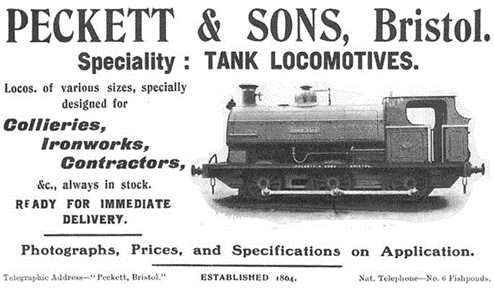
Two engines were used on the line, the first being A.J.Keeble, an 0-6-0 outside cylinder saddle tank, built by Peckett & Sons of Bristol in 1902, painted in Midland Lake and black with a brass dome. Unfortunately shortly after regular working started it was discovered the little engine could not always cope with the six wagons on the 1:60 gradient. The practice began of pushing the wagons from Grafton and pulling them back afterwards. On several occasions in wet weather the wheels lost their grip and the engine slid back to the level crossing.
A replacement engine was purchased in 1907 and the first engine went to the Wessington Light railway (The Wissey) in Norfolk. The new engine was also made by Peckett & Sons of Bristol, and was an 0-4-0 outside cylinder saddle tank, and was given the name Progress. This engine was painted bright apple green. Both engines were for exclusive use on the line but sometimes helped with shunting at Grafton station.
Building of the barracks was completed in 1910 and the line was dismantled just after. A sale was arranged by Allan Herbert, auctioneers of Andover, taking place in May 1912 when most of the machinery was sold. The little engine Progress was sent to Sanderson Bros and Newbold Ltd, Sheffield but was later scrapped.
Further articles like this of local interest can be found in the Bedwyn History Society’s newsletter The Chronicles, produced up to four times a year and available to members only. Membership is currently £15 a year which includes entrance to nine meetings. Membership enquiries to Steve Hobson on bedwynhistory@hotmail.co.uk.
Sue Challen
Newsletters – David Harris & Val Patrick
 Bedwyn History Society